
Projects & Missions
Build for a real purpose.
Explain every choice.
Bring several ideas together in an outcome that matters. Milestones, artifacts and reflection let educators see how learners plan, revise and apply their understanding.
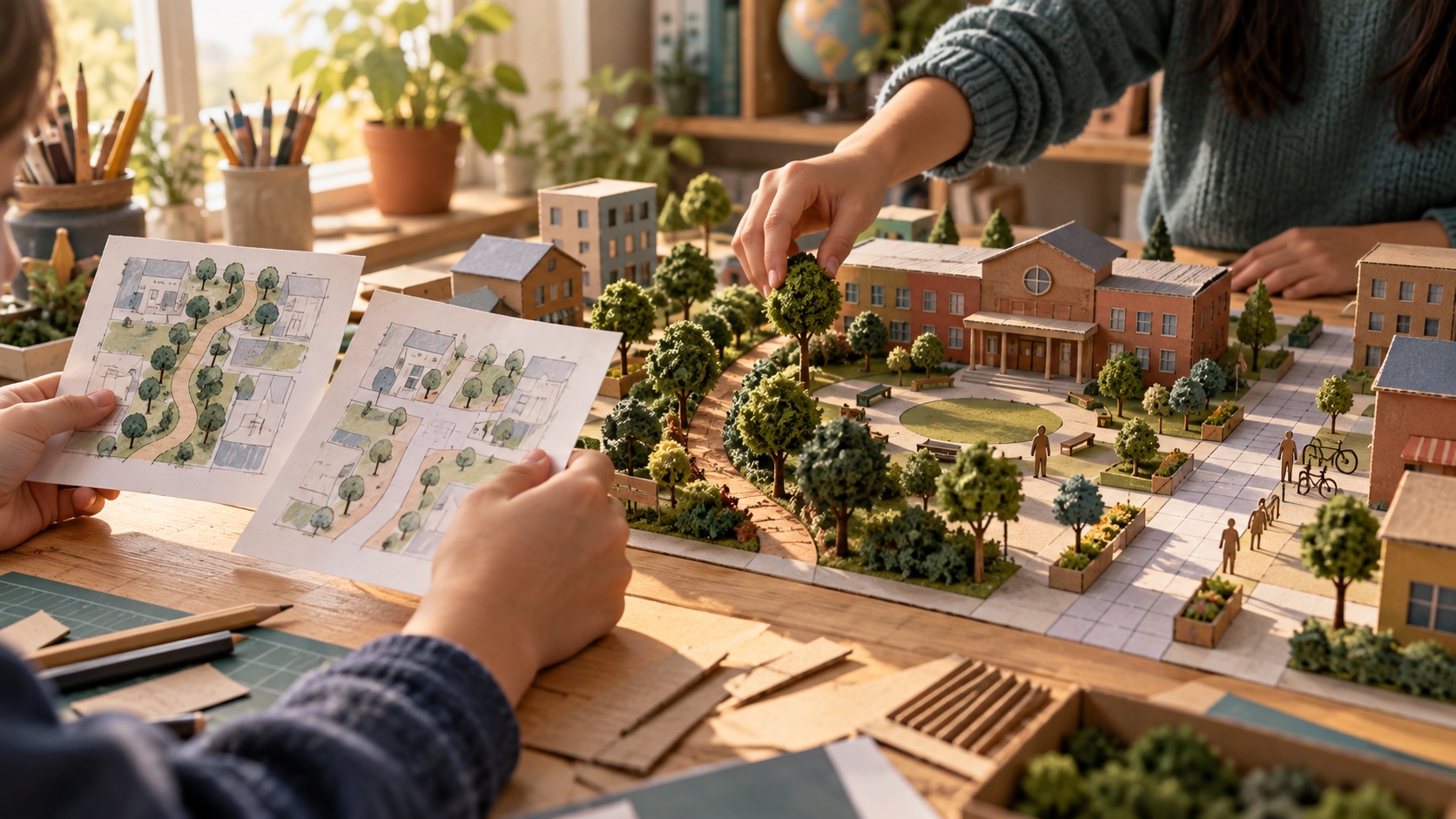
Give the outcome a learning reason.
A model, proposal or campaign exists to apply defined ideas and criteria, rather than to reward polish or production effort alone.
Make the process reviewable.
Milestones preserve plans, tests, feedback and changes so the final artifact does not hide how the learner reached it.
Use the work in a fresh constraint.
A changed audience, material or condition asks learners to adapt the reasoning instead of merely presenting the finished object.
FROM OBJECTIVE TO EXPERIENCE
Different subjects.
Purposeful possibilities.
Start with what learners should understand. Shape the experience around the thinking you want to see.
Design the Cool Route
Use shade, surface-temperature readings and distance to build a scale neighbourhood route, then defend one trade-off to a council panel.
Interpret local data and justify a design decision under competing constraints.
A Library for Every Reader
Audit a classroom library for different readers, prototype one practical improvement and revise it after structured user feedback.
Translate an access need into criteria, a prototype and an evidence-based revision.
Protect the Stream
Trace likely runoff around a school site, compare intervention ideas and propose a small test before recommending a wider change.
Apply water-flow concepts while distinguishing measured evidence from a proposal.
INSIDE A LEARNING MOMENT
Plan a cooler route through the neighbourhood.
A scale-model mission joins measurement, design and explanation around one practical question without pretending classroom data is a citywide study.
Which walking route balances shade, distance and safe access most effectively?
Define success
Set the route users, scale and criteria. Decide how shade, surface temperature, distance and access will be represented and compared.
Build from the evidence
Plot supplied observations on the model and draft two possible routes. Mark assumptions instead of presenting them as measured facts.
Test and revise
Use a peer or teacher review to identify one conflict between criteria, then change the route and record why the revision improves it.
Respond to a new constraint
Adapt the proposal when one shaded passage closes. Explain which evidence still applies and what new information would be needed.
The teacher reviews the criteria, decisions and fresh adaptation alongside the model before judging how well the learner applied the underlying ideas.
MAKE THINKING VISIBLE
Notice the reasoning.
Choose what comes next.
Use the response, the process, and the help involved to decide what a learner needs next. Educator judgment stays central.
Milestones and decisions
Plans, selected data and checkpoint explanations show how the learner turns an objective into a course of action.
Artifact and revision trail
The model or proposal stays connected to feedback, changed choices and the learner's reason for accepting or rejecting a suggestion.
Adaptation under a new constraint
A changed condition reveals whether the learner can transfer the reasoning beyond the polished final artifact.
EDUCATOR CONTROL
Your objective.
Your teaching decisions.
Create, adapt, review, and assign with the learning conditions in view.
Set scope, criteria and checkpoints
Define the objective, audience, time, available materials and rubric; choose milestones that expose learning rather than project management alone.
Review sources, safety and sharing
Approve data and fieldwork boundaries. Keep learner identities and work private unless an authorised audience and rights review permit sharing.
Offer accessible ways to contribute
Provide roles beyond fine-motor construction, accessible materials, keyboard-ready planning tools and equivalent oral, visual or written evidence.
Make assistance accountable
Set permitted templates, AI support, adult help and peer feedback. Keep assistance with the process record and check understanding in a new constraint.
Projects & Missions
Make something with a purpose.
Keep the learning inside every choice.