
Collaborative Activities
Build one answer together.
Hear each learner's thinking.
Discuss, investigate and make as a group while each learner contributes something visible. Shared work becomes evidence when roles, reasons and individual understanding remain distinct.
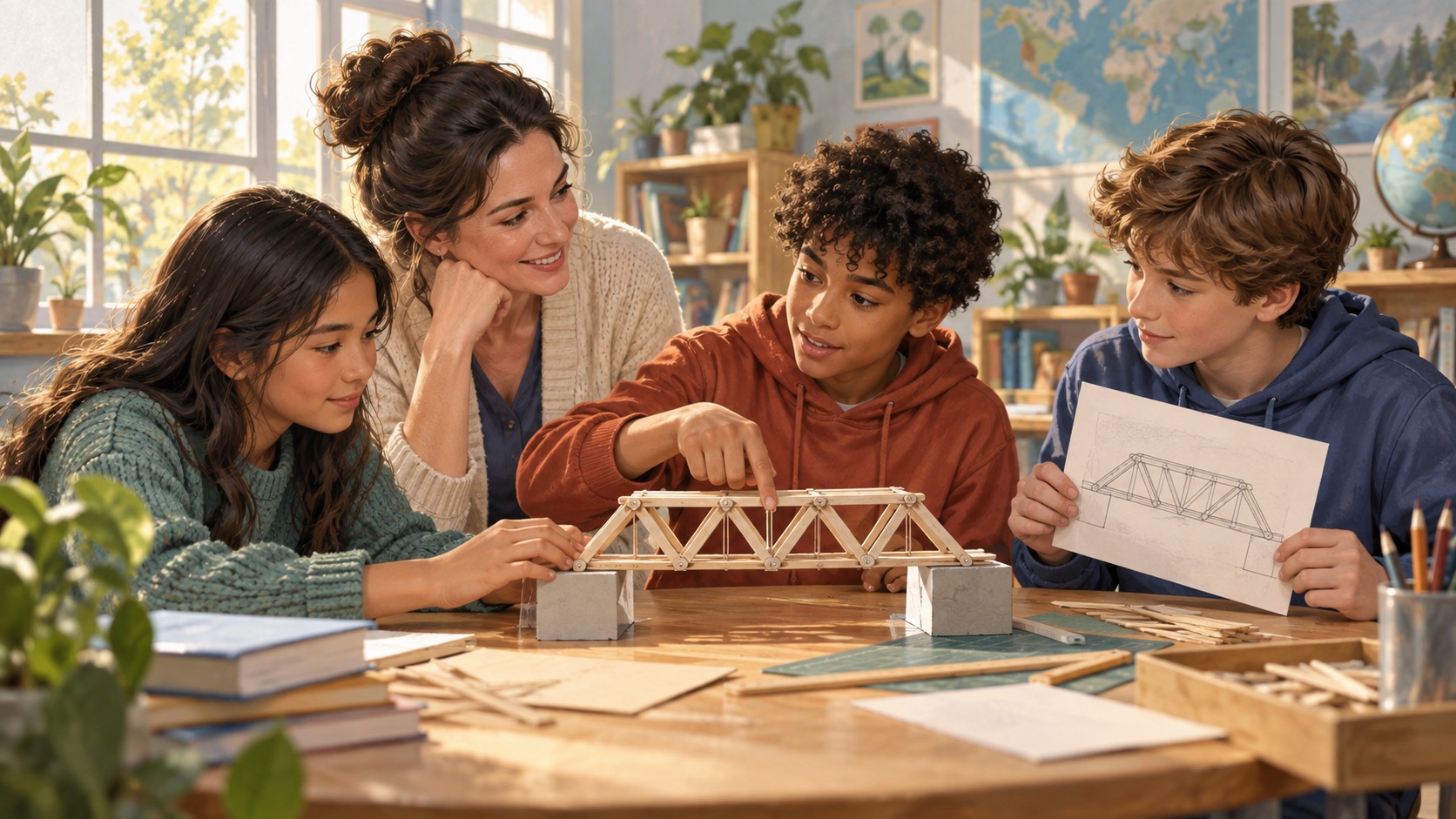
Make collaboration necessary.
Different observations, roles or constraints give learners a real reason to combine ideas rather than divide identical worksheet questions.
Keep contributions distinguishable.
The shared model or decision sits beside each learner's prediction, explanation, question or reflection.
Return to individual understanding.
A fresh prompt after the group task lets the teacher see what each learner can now explain or apply independently.
FROM OBJECTIVE TO EXPERIENCE
Different subjects.
Purposeful possibilities.
Start with what learners should understand. Shape the experience around the thinking you want to see.
Bridge Under Constraint
Combine material tests, a builder's prototype and a recorder's evidence to make a bridge, then revise after a fair load test.
Use evidence about forces and materials to justify a shared design decision.
Four Corners of the Watershed
Each learner traces water from a different zone, then the group joins the routes and predicts how one upstream change affects the whole map.
Explain connected water flows and contribute evidence to a system-level prediction.
Whose Account Changes the Claim?
Read different source cards privately, share only the relevant evidence and negotiate a claim that names both agreement and uncertainty.
Synthesize perspectives while preserving source limits and individual interpretations.
INSIDE A LEARNING MOMENT
Build a bridge from different kinds of evidence.
A small-group bridge investigation makes interdependence useful while preserving what each learner predicted, tested and understood.
How can the team build a light bridge that carries a set load, and which evidence should guide the design?
Begin with individual predictions
Each learner chooses a promising shape or material and records a reason before the group sees the test results.
Investigate through distinct roles
A materials tester, builder, load checker and evidence recorder complete linked tasks, with flexible role alternatives chosen by the teacher.
Make and revise one design
Combine the findings into a bridge, run an agreed load test and change one feature. Record whose evidence influenced the revision and why.
Explain a new bridge alone
Give each learner a different span or material limit and ask for an individual design choice supported by the group's findings.
The teacher considers the group artifact, contribution trail and fresh individual response together before choosing the next engineering question.
MAKE THINKING VISIBLE
Notice the reasoning.
Choose what comes next.
Use the response, the process, and the help involved to decide what a learner needs next. Educator judgment stays central.
Individual starting ideas
Predictions and role notes preserve what each learner brought to the group before discussion reshaped the plan.
Shared artifact and contribution trail
The model, discussion decisions and linked observations show how the group used evidence and where each contribution entered.
Fresh individual response
A changed constraint checks each learner's understanding without treating group success as identical mastery for everyone.
EDUCATOR CONTROL
Your objective.
Your teaching decisions.
Create, adapt, review, and assign with the learning conditions in view.
Design genuine interdependence
Set a shared objective, distinct information or responsibilities and a group outcome that requires ideas to meet.
Protect participation and privacy
Choose groups and discussion boundaries carefully. Keep learner work within the authorised class context and moderate any wider sharing.
Make every role accessible
Offer speaking and non-speaking contributions, flexible role changes, accessible materials, keyboard tools and private thinking time before discussion.
Set assistance and accountability
Define teacher prompts, peer help, sentence frames and AI limits; keep support visible and include a fresh individual check after the group task.
Collaborative Activities
Let the ideas meet.
Keep every learner's thinking visible.