
Explainer Animations
Set the idea in motion.
Ask before you show it.
Explain one concept through narrated motion, drawn in an animation style you choose. Each chapter ends on a question and the next chapter is the answer, so learners commit to their thinking before the picture shows it.
Let motion carry the mechanism.
Movement shows what a still picture cannot: a cause becoming an effect, a part moving into place, a quantity changing. Each chapter animates one step of the idea.
Hold the answer back.
Every chapter ends on a question. The answer is the next chapter, and it does not start until the learner has responded, so the picture never gives the answer away.
Watching is not the evidence.
A clear animation makes an idea easier to follow. Understanding shows in the answers at the end of each chapter, not in how much was watched.
FROM OBJECTIVE TO EXPERIENCE
Different subjects.
Purposeful possibilities.
Start with what learners should understand. Shape the experience around the thinking you want to see.
Area by Rearranging
A parallelogram is cut and its corner triangle slides across to make a rectangle. At the end of the chapter, learners predict whether a parallelogram that leans much further, on the same base and height, still has the same area.
Explain why a parallelogram's area is its base times its height, and apply it to an unfamiliar shape.
Through the Heart
Blood moves through the heart's four chambers one chapter at a time, with each valve closing behind it. Every chapter stops to ask where the blood goes next and why it cannot flow back.
Trace the path of blood through the heart and explain what a valve does.
How a Sentence Is Built
Words slide into place as subject, verb and object. A chapter ends by asking how the verb must change when the subject changes, before the next chapter shows it.
Identify the parts of a sentence and make a verb agree with a new subject.
INSIDE A LEARNING MOMENT
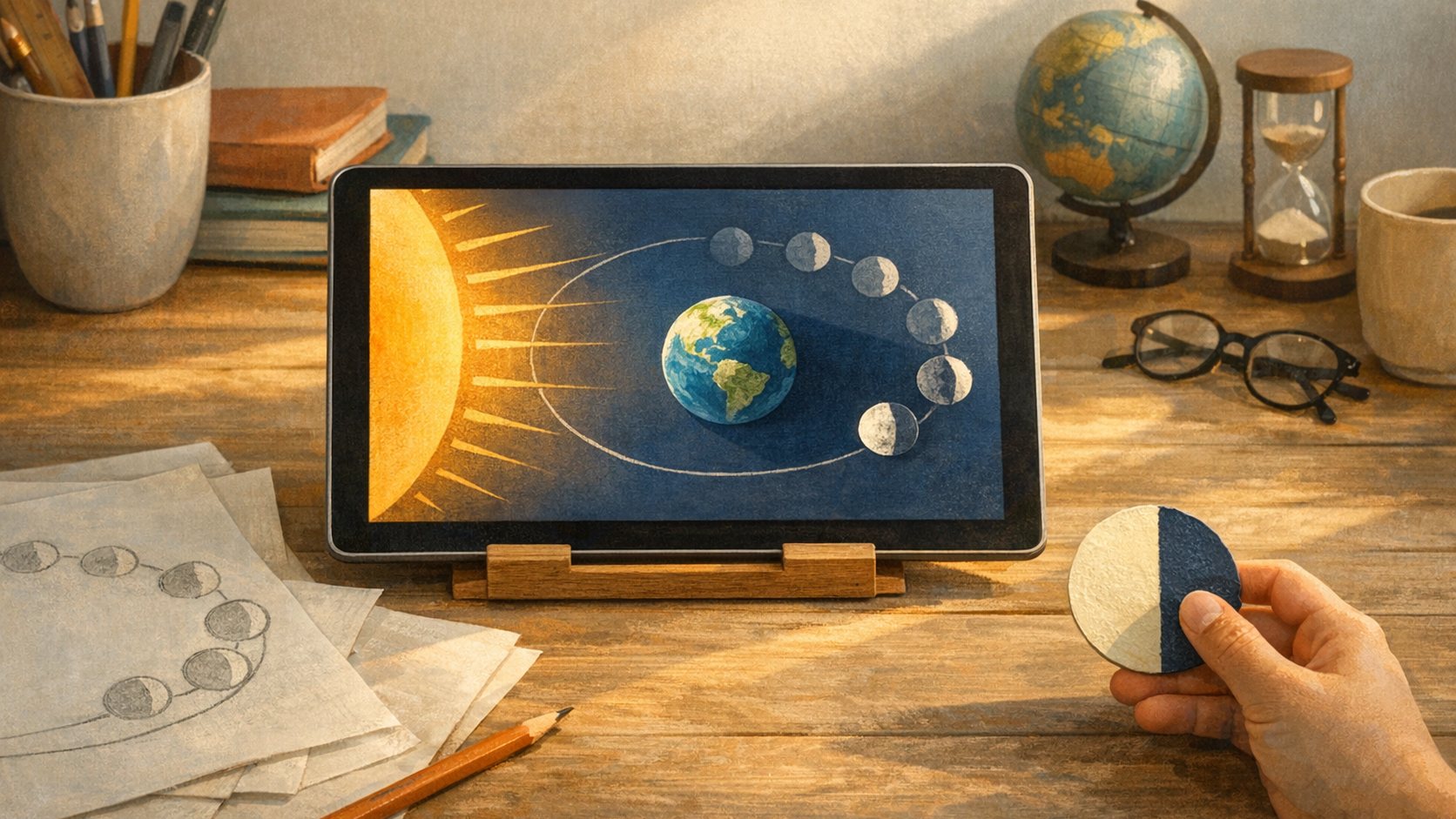
Follow the Moon's lit half.
A three-chapter explainer, drawn in the diagram and formula motion style, shows the Sun, Earth and Moon from above. Each chapter ends on a question, and the next chapter answers it.
Why does the Moon seem to change shape over a month?
Watch half of it light up
The first chapter draws sunlight falling on the Moon from one side as it circles Earth. The narration keeps time, the motion follows it, and the labels are drawn in the learner's language.
Answer at the chapter's end
The picture holds on its last moment and asks: when the Moon passes between Earth and the Sun, how much of its lit half faces us? Learners choose and give a reason.
See the answer in the next chapter
Only after the response does the second chapter begin, turning the view toward Earth to show a new moon. The answer is never on screen before the question is done.
Apply it to a moment not shown
The last chapter ends on a new case: what shape will someone on Earth see a week after a full moon? Learners answer from the lit half, not from a remembered picture.
The teacher reads the answers chapter by chapter to see whether learners reason from where the light falls or only recognise the shapes they watched.
MAKE THINKING VISIBLE
Notice the reasoning.
Choose what comes next.
Use the response, the process, and the help involved to decide what a learner needs next. Educator judgment stays central.
An answer before the reveal
The response at a chapter's end shows the learner's own reasoning, given before the next chapter could show the answer.
Where the explanation breaks
Answers chapter by chapter show which step of the idea holds and which needs another look, so the teacher can return to that step rather than the whole explainer.
Watching kept separate
Watching the animation produces no evidence on its own. Only the answers at the chapter ends count, so a finished explainer is never mistaken for mastery.
EDUCATOR CONTROL
Your objective.
Your teaching decisions.
Create, adapt, review, and assign with the learning conditions in view.
Choose the style, approve the script
Choose an animation style when you start, from whiteboard drawing and paper cut-outs to blueprints and pixel art. The story is written in chapters, and you accept the script before any chapter is animated.
Narrate every teaching language
Narration is generated and captioned in each teaching language, and the animation is timed to the voice in each one. Labels drawn inside the picture change language with it.
Review before learners watch
Watch the whole explainer with its narration and questions before you approve it; it stays in Draft until you do. The animation runs in a sealed sandbox with no network access.
Keep every way in open
Captions and a transcript come from the narration, nothing plays sound on its own, and the controls work by keyboard. Reduced motion removes movement that is only for effect and shows meaningful change as clear steps. Text in the picture follows the learner's text size.
Explainer Animations
Show how the idea works.
Ask before the answer appears.