
Printable Activities
Put the idea in their hands.
Keep the reasoning in view.
Fold, sort, measure, draw and discuss away from the screen. Printable activities connect physical action with an explanation and a teacher-observed next application.
Make the hands-on action essential.
Cutting, folding, sorting or measuring should reveal the relationship being learned, not serve as decoration around a worksheet.
Plan how evidence returns.
A teacher observation, marked sheet, brief explanation or optional upload keeps learning visible without making a device part of every step.
Change the materials, keep the idea.
A fresh object or arrangement checks whether the learner can apply the relationship beyond the prepared page.
FROM OBJECTIVE TO EXPERIENCE
Different subjects.
Purposeful possibilities.
Start with what learners should understand. Shape the experience around the thinking you want to see.
Fold, Compare, Prove
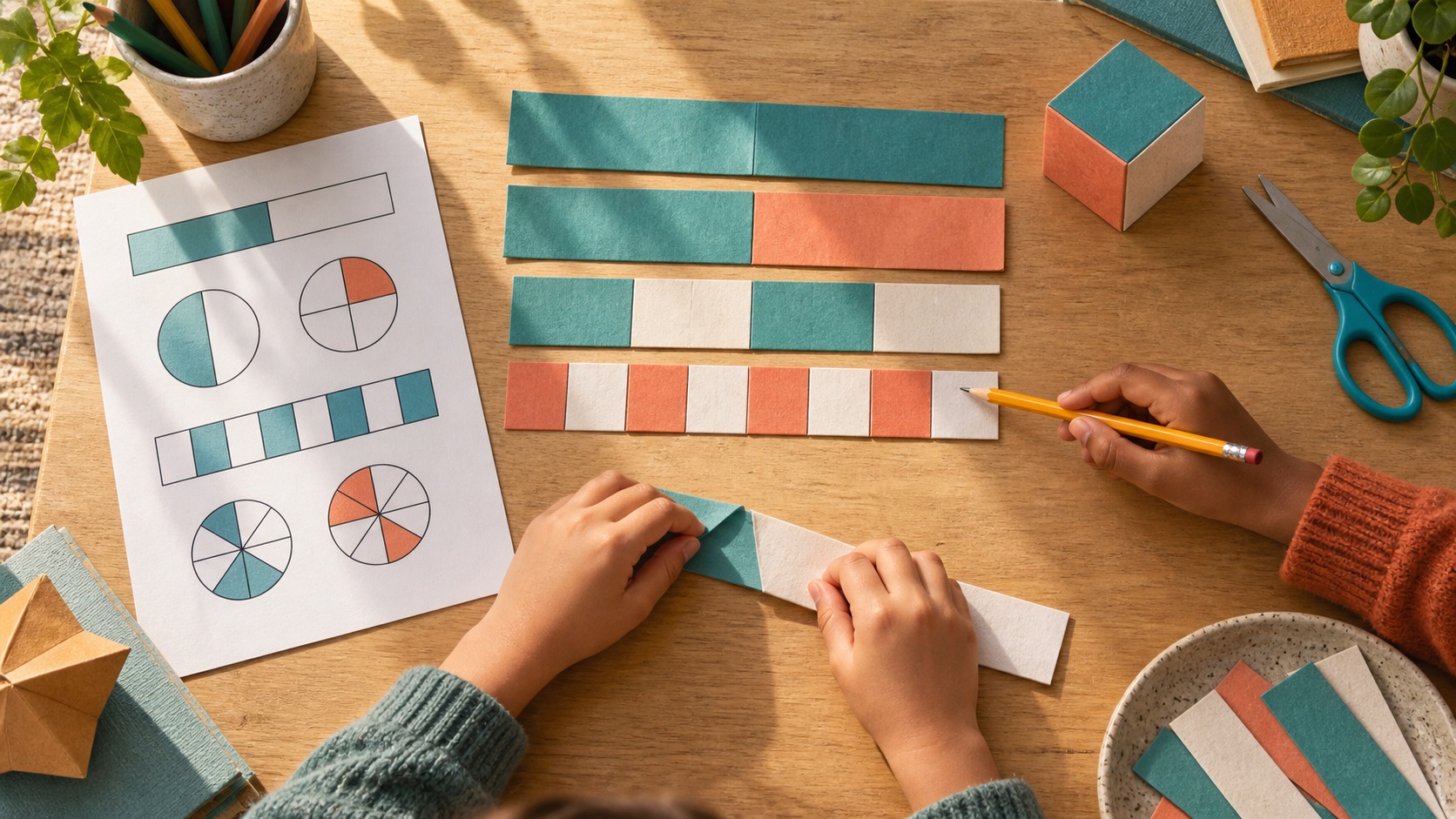
Fold equal paper strips into halves, fourths and eighths, align equal amounts and annotate one claim about equivalent fractions.
Construct and justify fraction equivalence using equal wholes.
Sort the Shoreline
Sort illustrated shoreline finds by observable features, write a rule for the groups and test it with one unfamiliar specimen card.
Classify from observable properties and revise a rule when new evidence appears.
Evidence on the Timeline
Arrange source cards around an event, distinguish date from inferred sequence and leave a visible gap where the evidence is uncertain.
Build a chronology while marking the limits of available sources.
INSIDE A LEARNING MOMENT
Fold a case for equivalent fractions.
Equal paper strips let learners feel and see partition size, then support a spoken or written proof that does not depend on a photo upload.
How can two differently divided strips show the same amount?
Prepare equal wholes
Check that every strip has the same length. Label one whole, then fold separate strips into halves, fourths and eighths.
Align equal amounts
Place one-half beside two-fourths and four-eighths. Mark the endpoints that line up and describe what changes and what remains equal.
Record the reasoning
Annotate the strips or explain aloud why the amounts match. The teacher records the claim and any physical or language support used.
Test a new fold
Use a fresh strip divided into sixths to build one-half, then justify the match without using the prepared labels.
The teacher can keep the marked strips or a brief observation, then decide whether to connect the idea to notation, a number line or another physical whole.
MAKE THINKING VISIBLE
Notice the reasoning.
Choose what comes next.
Use the response, the process, and the help involved to decide what a learner needs next. Educator judgment stays central.
The physical arrangement
Sorted cards, aligned strips, measurements or drawings show the learner's choices in relation to the objective.
An explanation or observation
A short written, oral or teacher-recorded reason makes the idea behind the hands-on work visible without requiring a public artifact.
A fresh material test
Applying the relationship to a new strip, object or card set helps distinguish following instructions from independent understanding.
EDUCATOR CONTROL
Your objective.
Your teaching decisions.
Create, adapt, review, and assign with the learning conditions in view.
Choose the physical learning move
Define what folding, sorting, measuring or arranging should reveal, and connect the teacher guide directly to that objective.
Review print and classroom safety
Check scale, contrast, reading level, material needs and age-appropriate cutting or handling. Keep learner work private by default.
Prepare equivalent participation
Offer large-print, high-contrast and low-ink versions, pre-cut pieces, tactile markers and a non-cutting route to the same reasoning.
Plan assistance and collection
Set partner, adult and template support; note it in observations and accept spoken, marked-paper or optional digital evidence without requiring an upload.
Printable Activities
Take the idea off the screen.
Bring the reasoning back to the lesson.