
Music Videos
Sing the rule.
Then put it to work.
Turn a fact, rule or sequence into a short original song whose video follows the lyrics. Learners sing it back, then pause to predict, apply or explain what the chorus taught them.
Let the song carry the structure.
The lyrics are the script and the song is the clock. Verses build the idea step by step, and the chorus returns to the rule learners need to remember.
Picture only what the lyrics say.
Every shot follows a lyric line. Pictures never add facts the song does not state, and diagrams that must be exact are drawn rather than generated.
Singing along is not the evidence.
A catchy chorus helps recall. Understanding shows at the pause points, when learners predict, apply or explain in a case the song did not sing.
FROM OBJECTIVE TO EXPERIENCE
Different subjects.
Purposeful possibilities.
Start with what learners should understand. Shape the experience around the thinking you want to see.
Times Tables on the Beat
Build the six times table verse by verse, then pause to use the pattern the chorus repeats to find a product the song never sang.
Use a multiplication pattern to find an unfamiliar product and explain the strategy.
Roots to Flower
Sing a verse each for roots, stem, leaves and flower, with every shot showing the part its line names. Pause to predict what happens when roots are damaged.
Connect each plant part to its function and apply that link to a new situation.
Words for the Weather
Sing a verse for each kind of weather, then pause to choose the word that fits a new scene and say what you would wear in it.
Recall new vocabulary and use it accurately in an unfamiliar context.
INSIDE A LEARNING MOMENT
Sing halves and quarters, then use them.
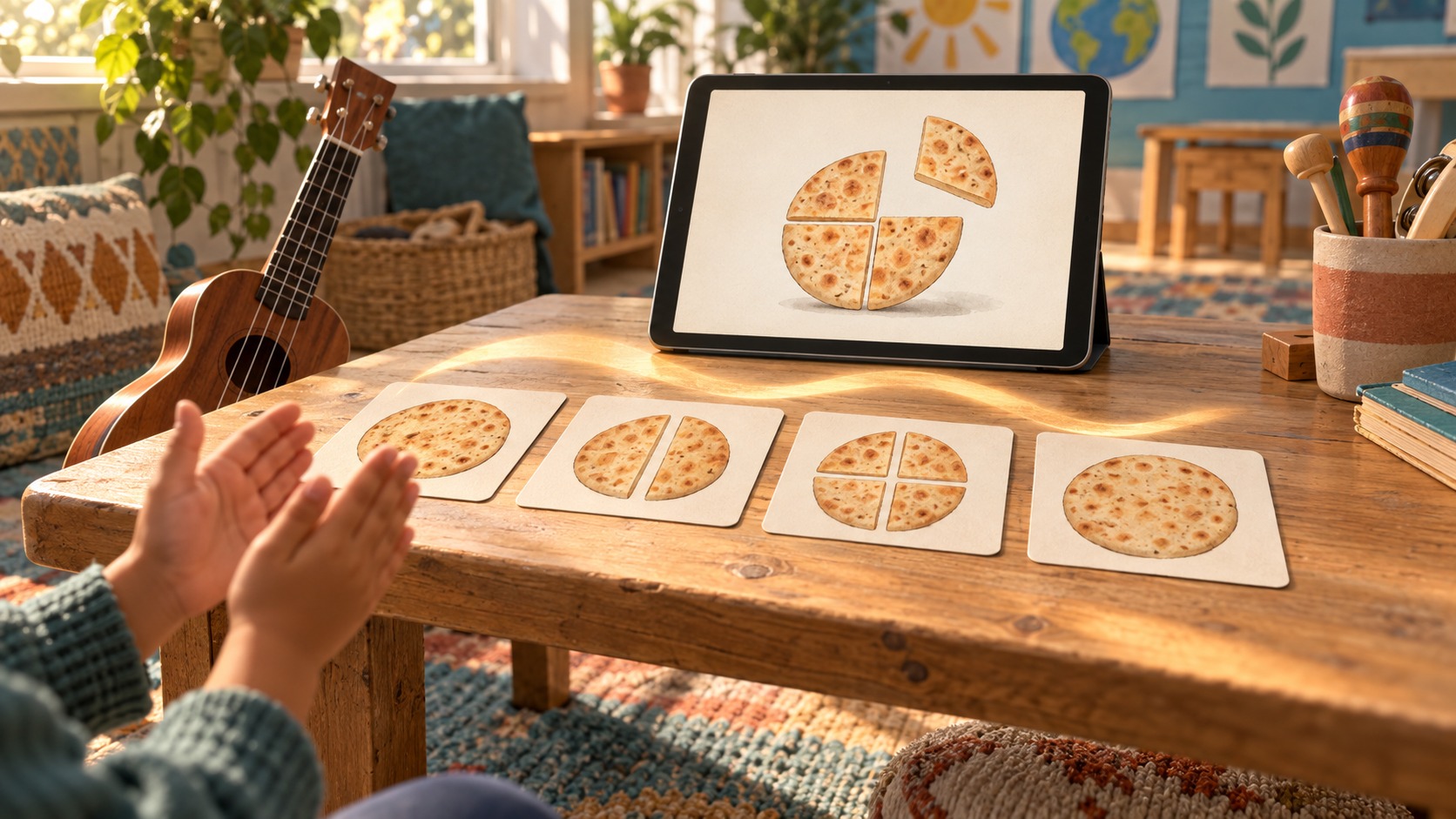
A 30-second song cuts one whole into fair pieces. The lyrics name each step, and one pause asks learners to use the rule on a shape the song never showed.
How many equal pieces make a whole, and what is each one called?
Listen to the first verse
One cut down the middle makes two fair pieces. The picture shows exactly what the line names, and the captions come from the approved lyrics.
Join the chorus
Two halves make one whole, and so do four quarters. Learners sing along while the chorus gives them the rule in words they can recall.
Pause and predict
After the chorus the video stops. How many pieces will there be if each half is cut again? Learners choose and give a reason before the last verse plays.
Apply it to a new shape
Without replaying the song, learners decide whether a rectangle cut into four unequal strips shows quarters, and explain why.
The teacher compares the prediction with the new-shape explanation to see whether learners use the rule or only remember the tune.
MAKE THINKING VISIBLE
Notice the reasoning.
Choose what comes next.
Use the response, the process, and the help involved to decide what a learner needs next. Educator judgment stays central.
A prediction at the pause
The response after the chorus shows whether the learner can carry the rule one step further than the lyrics went.
An application beyond the song
Judging a shape the video never showed reveals understanding that a memorised line cannot supply.
Engagement kept separate
Playback and singing along are recorded as engagement only, so a finished song is never mistaken for mastery.
EDUCATOR CONTROL
Your objective.
Your teaching decisions.
Create, adapt, review, and assign with the learning conditions in view.
Approve the lyrics first
State the objective, edit any drafted lyrics and approve their facts as text before a song or clip is generated.
Review the song and every shot
Songs are original and never imitate a named artist or an existing song. Listen before learners do, regenerate a rejected clip on its own, and keep the video in Draft until you approve it.
Keep every way in open
Captions or a lyric sheet are always available, with still, reduced-motion and audio-only versions. No flashing sequences, and no child appears as an identifiable real person.
Place the pause points
Choose where the song stops, what learners predict, apply or explain, and which hints sit beside their response.
Music Videos
Make the rule easy to remember.
Check that learners can use it.